
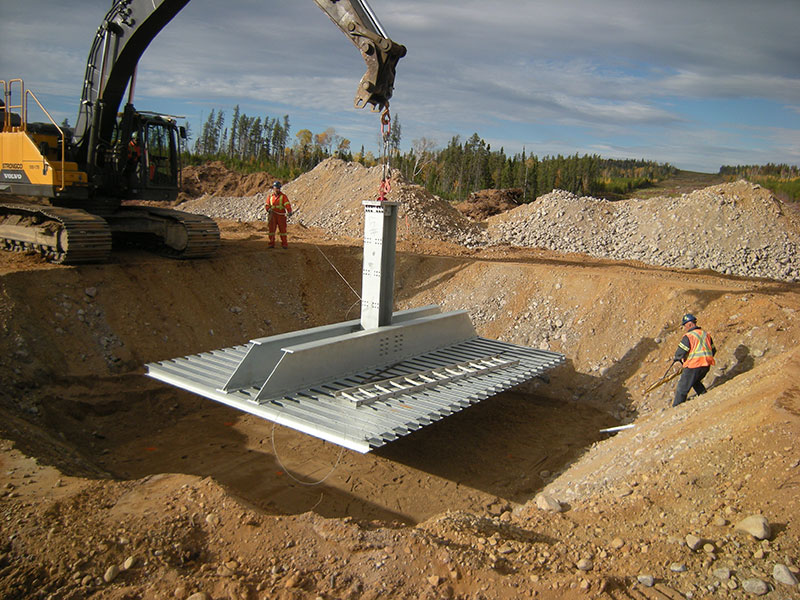
A transmission corridor of any length crosses several ground conditions. Competent rock at one structure, saturated silt two spans later, and permafrost or organic soils somewhere in between. The structures may be nearly identical. The foundations cannot be.
Start with the load cases, not the catalogue
Suspension, tension and dead end structures impose very different foundation demands. Uplift usually governs for lattice tower footings, compression for heavy angle structures, and overturning for single pole structures. Getting the governing case right for each structure type before looking at soil data avoids designing an elegant solution to the wrong problem.
Investigate where the risk is, not evenly
Uniform borehole spacing along a corridor wastes budget in ground you already understand and leaves you blind at the transitions. Desk study, terrain mapping and geophysics should be used to identify the boundaries, and the boreholes should be concentrated at those boundaries and at the heavy structures.
Choose a small number of standard designs
Constructability improves sharply when the contractor is building three or four repeated foundation types rather than forty individual designs. We aim for a standard drilled pier, a standard grillage, a rock anchor detail and a raft, each with a defined range of applicability, and we accept some conservatism in exchange for schedule certainty.
Verify in the field and be willing to change
The design assumption is a hypothesis. Pier spoil, drilling rates and pile driving records all test it. A design that has no defined field verification step, and no pre-approved alternative if the assumption fails, will produce a change order instead of a decision.